
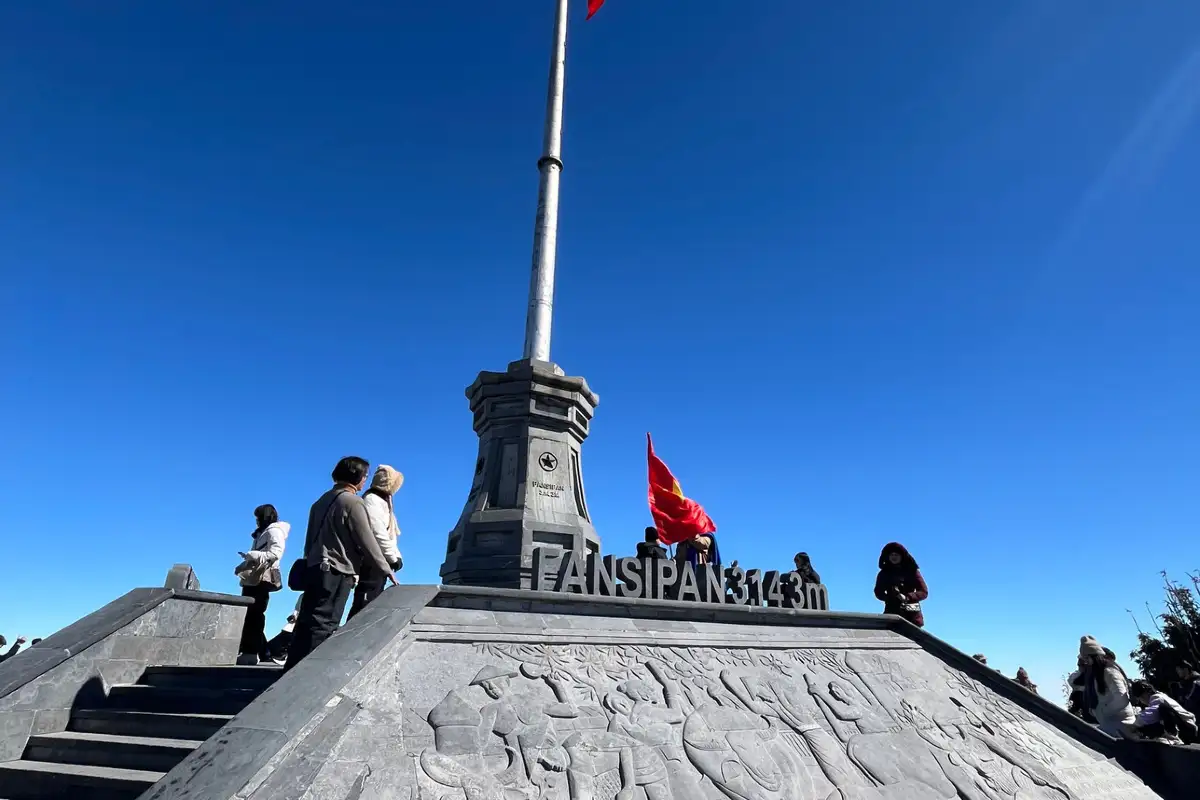
There is a moment every visitor remembers: the last stairs, the flag tower, and the summit marker that says FANSIPAN — 3,143 m. You are standing on the highest point of the entire Indochinese peninsula — higher than anything in Vietnam, Laos or Cambodia — and you did not have to hike for two days to get there. This guide covers the top of the mountain: the true height of the peak, the ~600 final steps (and the funicular alternative), the summit sanctuary, and how to enjoy 3,000-plus metres comfortably.
Key takeaways
- 3,147.3 m is the surveyed height of Fansipan — the 1909 measurement said 3,143 m, and the summit topiary keeps the classic number.
- The last leg is a walk: roughly 600 steps from Fansipan Station through the pagoda complex — “steep and arduous, but rewarding,” as one reviewer puts it.
- Prefer to ride? A short summit funicular covers much of the final climb for a gentler finish.
- Dress warm: the summit air is thin and the temperature sits far below Sa Pa town’s, in every season.
- The complex opens 07:30–16:00 with tickets until 2:00 PM — the summit deserves at least two of your recommended 3–5 hours.
Quick answer: every ticket reaches Fansipan Station; the summit marker is a 20–40 minute stroll-climb away. Book from $32.11 through Trip.com and take the roof at your own pace.
How high is Fansipan, really?
The mountain’s height has a history. The 1909 French survey measured 3,143 m, and that number stuck — it is the one painted on the summit marker and topiary, and the one travelers quote (“the Roof of Indochina is at 3143m ASL on the Hong Lien Son Mountain,” as one review puts it). Modern surveys refined the figure to 3,147.3 m. Both are correct; the mountain simply got a more precise ruler. Either way, no higher summit exists between the Himalayas and nowhere — Fansipan is the crown of the Indochinese peninsula.
The classic marker makes the most-photographed backdrop in Sa Pa. Come early and you will have it nearly to yourself; come at midday and join a cheerful queue of flag-wavers from four continents.
The ~600 steps — and the funicular alternative
Fansipan Station delivers you into the gardens well above the treeline; the summit marker waits above. Two ways up:
- The staircase route (~600 steps): stone steps wind through archways, gardens and pagoda terraces. The altitude makes it feel steeper than the number suggests — travelers describe it as steep and arduous but absolutely worth it, and there are plenty of places to stop and pretend you are photographing the view.
- The summit funicular: a short ride that covers much of the climb for a gentle finish — the practical pick for families with small kids, older travelers, or anyone saving their knees for the walk back down.
Neither route is a technical hike: this is a landscaped sanctuary, not a trailhead. Sensible shoes are enough; the mountain supplies the drama.
Pacing tip: at 3,000+ m the air carries about a third less oxygen than the coast. Take the stairs slowly, sip water, and let the views be your excuse to stop — everyone else is stopping too.
The summit sanctuary: pagodas and the Great Buddha
The summit is not just a marker — it is a full spiritual complex spread along the ridge. Linh Ung Pagoda crowns the plateau with its curved roofs and courtyards; the bronze Great Buddha — an Amitabha statue about 21.5 m tall, cast from over 60 tonnes of bronze — watches over everything; and a path of arhat statues lines the approach. Details and legends live in our Linh Ung Pagoda guide.
And then there is the weather show. On clear mornings the sea of clouds fills every valley below while the peaks break through like islands — the image Sa Pa’s tourism was built on. When mist rolls in instead, the complex turns into something quieter and stranger: temple roofs materializing out of white, the Buddha’s silhouette dissolving and reforming. Reviewers are unanimous that both versions land: “Even though the weather was misty, it was still an overwhelming experience to be on top of Fansipan.”
Comfort at 3,000 metres
| Condition | What it means | What to do |
|---|---|---|
| Thin air | Noticeably less oxygen than Sa Pa town | Climb slowly, pause often, hydrate |
| Cold | Far below town temperatures, windy on the ridge | Warm layers + windproof jacket, even in summer |
| Fast-changing mist | White-outs appear and lift within hours | Wait it out over coffee; mornings are clearest |
| Strong sun | UV intensifies with altitude | Sunglasses and sunscreen — yes, even in fog |
| Winter frost | Icy patches on steps some mornings | Grippy shoes; follow staff guidance |
Food and drink are available around the stations and summit stalls, and the facilities — “clean and well maintained,” per reviewers — make the altitude easy. Plan the summit as the heart of your 3–5 hour visit and the day balances itself.
Frequently asked questions
Is the summit marker exactly 3,143 m?
The marker keeps the classic 1909 figure of 3,143 m; modern surveys put the true summit at 3,147.3 m. Both numbers refer to the same mountain — the marker is where everyone takes the photo.
Can children and older travelers make the final climb?
Yes — via the short summit funicular, or by taking the steps slowly. Families report the whole trip works well; read the family guide for the details.
How cold does it get?
Summer summit days can feel like autumn; winter mornings regularly sit near or below freezing with wind chill. Frost and occasional snow appear in cold snaps — see the winter guide.
What if the summit is in cloud?
Mist usually lifts by late morning. If it does not, the sanctuary still rewards the trip — and the cable-car descent often punches back out through the cloud layer for the best views of the day.
How much time should the summit get?
At least two hours: the gardens, the pagoda, the Buddha plaza, the marker and a coffee. Reviewers who planned half a day “ended up spending the whole day.”
Book your summit day
The roof of Indochina is a ticket away
From $32.11 online — instant e-ticket, no counter queue, and 3,147 metres waiting at the top.
Then go deeper: the cable-car guide covers the record span, the pagoda guide covers the sanctuary, and the one-day itinerary shows how it all fits into a single Sa Pa day.
Sources & official references
- Fansipan summit height: 3,147.3 m per modern survey; 3,143 m per the 1909 measurement (signposted on the mountain).
- Trip.com — Sun World Fansipan Legend listing (checked November 2026): hours 07:30–16:00, tickets until 2:00 PM, 3–5 hours recommended, No. 1 of Best Things to Do in Sa Pa.
- Verified traveler reviews on Trip.com (51,225 reviews, 4.6/5 average) for the summit climb, weather and facilities.
- Ticket-inquiry hotlines +84-974097866 and +84-948309999 for conditions and accessibility.
