
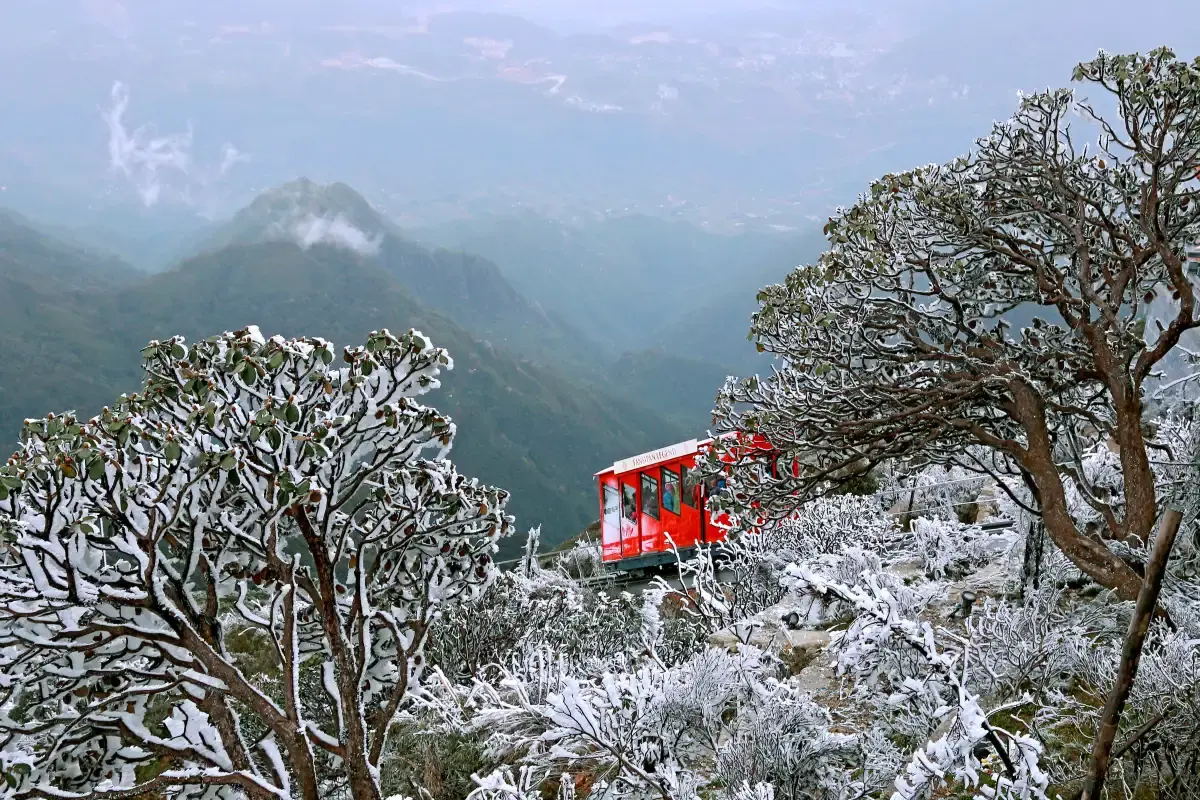
Ask Sa Pa regulars for their favorite season on Fansipan and a surprising number say winter. From December to February the air turns dry and transparent, the summit gardens wear hoarfrost on the coldest mornings, and — in genuine cold snaps — actual snow dusts the pagoda roofs. The cable car runs all winter; the crowds are the year’s thinnest; and the Roof of Indochina shows you views that summer visitors only hear about. This guide covers the cold-season mountain: what closes, what freezes, what to wear and why it might be the best month you could pick.
Key takeaways
- Clearest skies of the year: winter’s dry air delivers the long views — ridge after ridge, sometimes into China.
- Real cold: the summit at 3,147.3 m sits near or below freezing on winter mornings with wind chill; dress for it.
- Frost and snow happen: cold snaps can dust the gardens — rare, brief and beautiful; icy steps are the practical hazard.
- The rides run all winter (07:30–16:00, tickets until 2:00 PM); severe icing can pause individual segments for safety.
- Check before you go: the hotlines +84-974097866 / +84-948309999 post the day’s operating status.
Quick answer: winter is rideable and rewarding — book normally through Trip.com, dress in layers, and aim for the first cabins of the morning.
Why winter works
Vietnam’s northwest has two air regimes: the humid summer monsoon and the dry winter monsoon. Winter wins for visibility — cold, dense air holds less haze, and the mist that wraps the summit in July is a rarity in January. The light turns crystalline, the rice terraces have given way to neat golden stubble and winter crops, and the sea of clouds still forms in the valleys on calm mornings. Photographers call it the honest season: what you see from the summit is what the map promises.
Crowds thin too. Between the holiday spikes (Christmas–New Year, Tet), a winter weekday can feel like a private mountain — the first cable car, an empty Buddha plaza, and hot coffee at the top with nobody in the frame.
Frost, ice and snow
Sa Pa town at 1,500 m sees chilly mornings and occasional frost. Fansipan’s summit, a full 1,600 m higher, plays a different game: hoarfrost on the gardens and railings is common on clear cold mornings, and strong cold-air outbreaks can deliver genuine snowfall — the event that floods Vietnamese social media whenever it happens. Snow rarely settles for long, but the transformation is total: pagodas in white, the Great Buddha above a frosted garden, breath-clouds in the air.
- Icy steps are the real hazard — the ~600 summit stairs can glaze overnight. Grip-soled shoes, handrails, and the summit funicular on icy days.
- Frost burns off fast once the sun climbs — morning arrivals see the magic; noon arrivals see wet stone.
- Snow days are operating days until icing forces pauses — check the hotlines rather than assuming.
What to wear (seriously)
| Layer | Why | Notes |
|---|---|---|
| Base + mid layers | Temperatures swing from town to summit | Thermal base, fleece or wool mid — zip options beat pullovers |
| Windproof shell | The ridge wind is the real cold | Hood helps; the cable car exit is exposed |
| Warm accessories | Extremities freeze first | Beanie, gloves, thick socks — buy in Sa Pa cheaply if caught out |
| Grip shoes | Frosty stone steps | Any trail shoe; leave smooth soles for summer |
| Sun protection | Altitude UV + winter glare | Sunglasses and SPF — yes, at 0°C |
The town-to-summit delta can exceed 15°C in winter. Locals dress like it is two trips, because it is: autumn in the valley, late alpine autumn at the top.
Winter operations and closures
The complex runs its normal 07:30–16:00 schedule through winter, with tickets until 2:00 PM. Severe icing is the one force that pauses individual rides — safety departments test the lines on freezing mornings, and segments reopen as conditions allow. The pattern travelers report: town-side operations run normally while the summit funicular opens later on icy mornings, or the reverse. A phone call settles it in a minute: +84-974097866 or +84-948309999.
From real trips: winter visitors consistently rank their days among the best — thin crowds, glassy air, frost gardens and hot drinks against a blue mountain backdrop. The ones who struggled simply underdressed; the ones who dressed right got the mountain at its most cinematic.
Frequently asked questions
Does Fansipan really get snow?
Yes — occasionally, in strong cold snaps between December and February. It rarely lasts a full day, which makes catching it a matter of luck and flexibility; follow local weather channels and the hotlines.
Is the cable car safe in winter?
The system is engineered for alpine conditions and inspected daily; icing — not cold itself — is what can pause rides, and only until conditions clear.
What is the winter temperature at the summit?
Roughly 0°C on typical mornings, colder with wind chill, milder in afternoon sun. Sa Pa town sits around 8–12°C in the same hours.
Are the gardens still worth seeing in winter?
Different kind of worth — frost-rimed topiary and clear-sky lookouts replace the flower beds; spring brings the blossoms back.
Do I need to book differently in winter?
No — same tickets from $32.11 online. Pick a flexible fare type in case icing shifts your morning, and read the ticket guide for fare types.
Book the cold-season ride
The clearest skies of the year are the coldest ones
From $32.11 online — ride up into the transparent season and meet the frosted summit.
Then fine-tune: the best-time guide compares all four seasons, the summit guide preps the cold climb, and the one-day itinerary slots the mountain into a winter trip.
Sources & official references
- Trip.com — Sun World Fansipan Legend listing (checked November 2026): hours 07:30–16:00, tickets until 2:00 PM, 3–5 hours recommended.
- Ticket-inquiry hotlines +84-974097866 and +84-948309999 for winter operating status.
- Fansipan summit: 3,147.3 m (modern survey) — alpine conditions ~1,600 m above Sa Pa town.
- Verified traveler reviews on Trip.com (51,225 reviews, 4.6/5 average) for winter, frost and visibility reports.
