
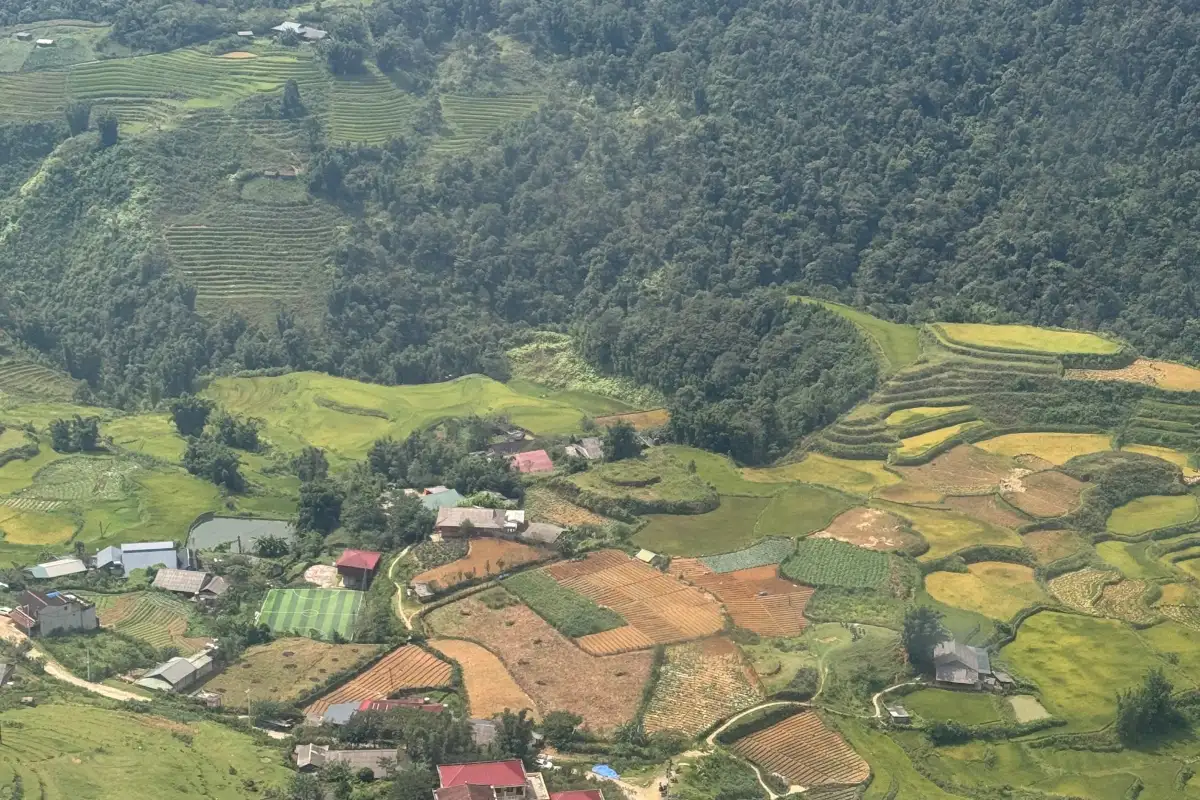
The rice terraces are why Sa Pa exists on postcards — and Sun World Fansipan Legend is the only place where you see them from above, unrolled across the whole valley at once. The cable car crosses the staircase fields in its first minutes, the summit looks down on the entire patchwork, and the seasons repaint it twice a year: emerald through the growing months, burning gold at the September–October harvest. This guide maps the views, the seasons and the photo logic that makes terrace shots from Fansipan look effortless.
Key takeaways
- September–early October is harvest gold — the single most photogenic window of the year.
- May–August grows the emerald version: vivid green terraces under dramatic monsoon clouds.
- The best vantage is the ride itself: the cable car’s opening minutes cross the terraces; corner-cabin positions win.
- From the summit the whole valley reads as one composition — widest possible view of the Hoang Lien terraces.
- Winter trades green for geometry: stubble, winter crops and the clearest air of the year.
Quick answer: time the trip to the terraces with a ticket from $32.11 via Trip.com — the ride does the climbing, you do the shooting.
The terrace calendar
| Months | State of the terraces | Photo character |
|---|---|---|
| Apr–May | Water-filled paddies, spring planting | Mirror terraces catching the sky — the connoisseur’s season |
| Jun–Aug | Full growth, deep emerald | Lush greens under monsoon clouds; mist adds depth |
| Sep–early Oct | Ripening to harvest gold | The famous golden staircases — book early, this is peak season |
| Nov–Mar | Stubble, winter crops, rest | Geometry and texture in the year’s clearest air |
The listing puts it plainly — “admire the stunning views of Sapa Rice Terraces and the picturesque Hoang Lien Mountains” — and the ride is what delivers it: reviewers consistently call the terrace sweep beneath the cabins a highlight before the summit even starts.
The three Fansipan vantage points
- From the cable car: the terraces roll directly beneath the first minutes of the span — moving-postcard territory. The lower you are, the closer the fields.
- From the funicular: the Muong Hoa leg skims garden level with valley frames through the windows — slower, closer, great in golden light.
- From the summit: the widest shot of all — the entire valley system laid out below the Buddha plaza and the lookouts. Come early for haze-free air; winter afternoons are crystalline.
Composition tip: from the summit, shoot the terraces against a ridge line — the staircases compress into abstraction when they meet the shadowed slopes. A standard zoom covers both the wide and the compressed version.
Photo technique from a moving cabin
Cabin photography is a fight with reflections and motion, and both are winnable. Stand close to the glass to kill interior reflections; brace elbows and camera against your body; and shoot with a fast shutter (1/500s or quicker) to freeze the landscape as it slides. Morning light rakes across the terraces and makes the water-filled paddies glow in April–May. Phones handle this well too — tap-lock focus, burst mode, and let the burst pick the sharp frame.
The ride down is the second chance: afternoon light comes from behind the summit, warming the valley — many photographers deliberately save their terrace shots for the descent.
Beyond the ride: valley viewpoints
Fansipan gives you the aerial view; the valley paths give you the human-scale one. Classic terrace viewpoints around Sa Pa (Ta Phin, Lao Chai, Ta Van, the Muong Hoa valley trailheads) put you in the fields themselves — and pair perfectly with a mountain morning: ride at 07:30, descend by late morning, then walk a terrace trail while the light stays long. Travelers returning to town describe exactly this rhythm — mountain first, “beautiful terraced scenery” on the way home.
From real trips: the guests who rave loudest combined both scales in one day — the record ride for the aerial gold, then a valley walk at ground level. “Along the way we saw beautiful terraced scenery… it gave the whole trip a perfect ending,” one visitor wrote.
Frequently asked questions
When are the terraces golden?
September to early October — harvest time. Dates shift with each valley’s planting, so late September is the safest bullseye; the best-time guide covers the whole year.
Can you see the terraces from the cable car?
Yes — the span crosses the valley directly above them. Corner cabin positions and a fast shutter are all you need.
Is the summit view better than the valley viewpoints?
Different: the summit gives the wide aerial composition; the valley trails give texture and people. The best trips do both — the mountain in the morning, a trail in the afternoon.
What camera gear do I need?
None beyond a phone. For dedicated shooters: a standard zoom, a fast shutter for the cabins, and a polarizer for the water-filled paddies in spring.
Does mist ruin terrace views?
Mist can hide the valley — but it often burns off by mid-morning, and the summit frequently sits above the cloud layer while the terraces stay visible beneath it.
Book the view
The terraces, from a world-record cable car
From $32.11 online — the only viewpoint that shows Sa Pa’s staircases from above.
Keep planning: the cable-car guide preps the cabin shots, the one-day itinerary pairs the mountain with a valley walk, and the first-timer tips fill the gaps.
Sources & official references
- Trip.com — Sun World Fansipan Legend listing (checked November 2026): “admire the stunning views of Sapa Rice Terraces and the picturesque Hoang Lien Mountains.”
- Verified traveler reviews on Trip.com (51,225 reviews, 4.6/5 average) for terrace seasons and descent-light photography.
- Sa Pa agricultural calendar — harvest window September to early October, water-mirror season April–May.
- Ticket-inquiry hotlines +84-974097866 and +84-948309999.
